Whole food vitamin C is the kind I choose for my family. Vitamin C acts 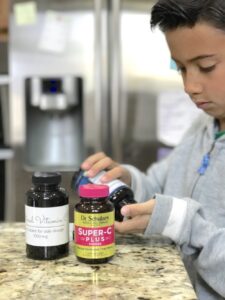 as an antioxidant, anti-inflammatory agent, assists in collagen formation, boosts the immune system and is necessary in the synthesis of stress hormones. Additionally, Vitamin C also helps your body absorb other nutrients, like iron! It is a very necessary vitamin for our bodies.
There are a couple of things to know before you go choose your source of Vitamin C. Here is what I have learned:
1. The source matters!
Here is what that means: Most of the vitamins sold to consumers come from a synthetic (lab-made) source. What this means is they are not getting vitamins and minerals from the earth and natural sources. They are instead making them in a lab and tt’s usually fermented from corn sugar in a lab.
Here is one thing to think about: When something is not sourced from a natural source your body will have a more difficult time recognizing it, and this lab made ascorbic acid form depletes the natural Vitamin C from the body.
When your body does not recognize it, then it does not know how to use it and will simply dump it or store it. Waste. Not just your money but your time and energy.
If there is one thing you will pick from my blog, it is that I do not like to waste my time, energy and money. Who does? But what we do not recognize is that we do it way more than we know because we do not know a better way.
2. Ascorbic or Ascorbate Acid
At your local health food store or grocery store the Vitamin C label will read: “Vitamin C as Ascorbic Acid or Ascorbate” for the main ingredient. Do not be tricked by the ones that say “with rose hips!” They are still mostly made up of ascorbic or ascorbate acid.
 Contrary to what most pharmaceutical companies or health companies want you to believe, ascorbic acid is not a natural Vitamin C. Ascorbic acid is only a fraction of the factors that make up a whole food Vitamin C.
Without the other components of Bioflavonoid, Rutin and J & K factors this type of Vitamin C is incomplete.
Many believe this forces the body to pull these nutrients from its own reserves to complete the Vitamin C complex. Whole food Vitamin C comes with all of these cofactors already in place.
The companies that sell you ascorbic acid as Vitamin C make this up synthetically in a laboratory. Instead of extracting from the whole food so they can save money. Ascorbic acid is very easy and inexpensive to mix together. Most of it is made by fermenting glucose, usually from corn, and processing it in a lab.
So most ascorbic acid starts with corn sugar and goes through a chemical process in a lab, very different from Vitamin C in an orange, cherry or amla berry.
The Research on ascorbic acid
There was an interesting study done at the University of Southern California. It was conducted by the lead researcher, James Dwyer, an epidemiologist from the Keck School of Medicine.
The study was done with a group of 573 men and women. People who had taken a supplement of Vitamin C “as ascorbic acid” over the past year and a half, and then some that had not. The study results showed that those who had consumed the Vitamin C had more evidence of possible future atherosclerosis (hardening of the arteries) compared to those who did not take Vitamin C pills at all!
How can they see these effects?
- To gauge the Vitamin C effects the researchers performed ultrasound measurements of the subject’s carotid arteries, which are in the neck. This method is a medically accepted substitute for probing coronary arteries directly.
- The study was performed by using just 500 mg per day of Vitamin C “as ascorbic acid” over the study period. For comparison, the RDA for adults is only 75 to 90 mg a day.
- ultrasounds were then performed a second time and the results showed that after consuming only 500 mg a day, the inner artery wall lay
 er was 2.5 times thicker than that of those that did not take any of the synthetic Vitamin C. Among smoking supplement takers, the inner artery walls were 5 times thicker. Physicians say such thickening precedes atherosclerosis.
The researchers did not say why, but I believe the form of Vitamin C matters, and this is one reason I choose whole food sources.
What the article failed to point out however, is that true whole food Vitamin C is very beneficial as an antioxidant. It assists in collagen formation, boosts the immune system and is necessary in the synthesis of stress hormones.
This study was published as an article in the Los Angeles Times, in 2000 on March 3rd by Terrence Monmaney.
3. Knowledge is power
Millions of Americans like those in the study are consumers of ascorbic acid and corn syrup type “Vitamin C”. They do not know it and thus are being recipients of the harmful and negative side effects. Why then do these companies continue to sell them to the public? The answer is “Profits.” Health companies and pharmaceutical companies can make larger profits by selling cheap imitations of Vitamin C and other supplements. Corn syrup is very cheap, this is why it is used as a sweetener in everything.
The Solution: Whole Food Vitamin C
There ARE whole natural forms of Vitamin C available.
The Vitamin C options below deliver a high potency amount from organic whole food sources. Such as: acerola cherry, organic oranges, blueberries, amla berry, and cranberries. Additionally, they contain bioflavonoids such as organic amla fruit, organic rosehips and organic green pepper. Now those your body will recognize!
- These are not synthetic and contain NO ascorbic/ascorbate acid.
- They contain the highest quality of unprocessed fruits, fruit juices & flavonoids.
- None of these are processed to separate any of the whole food constituents out.
- Very low temperatures are used as well in the dehydration of the fruits in order to keep intact the nutrient and enzyme content.
I have found several options in different forms for different ages.
When you are sick taking 1000mg of a natural vitamin c daily is huge is getting better.
SHOP
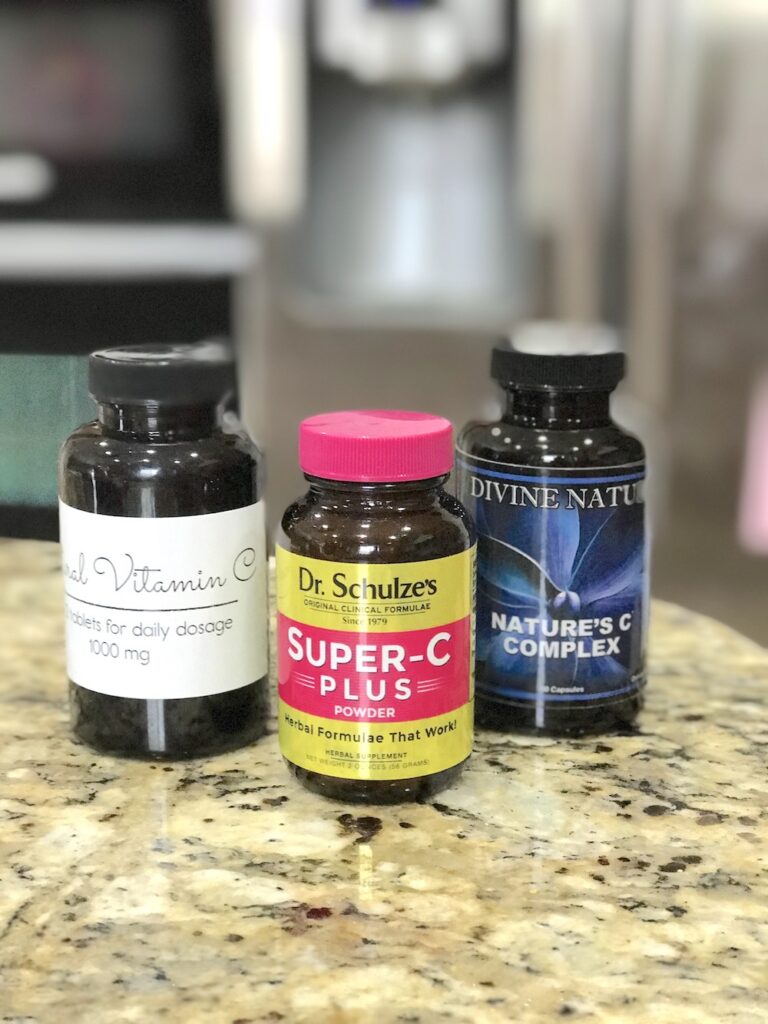
- Powder form for shakes and babies: Dr. Schulze Super C, the taste is not as good as the others on this one
- For babies and kids: Dr. Christopher’s vitamin and mineral liquid tincture, I have not tried this one.
- For adults and kids in a capsule form: Divine Nature Vitamin C , you can open these and have a powder. It tastes better than Dr. Schulze but not as good as the chewable.
- Chewable for babies and kids: Natural Vitamin C is a chewable and you can easily crush it into powder with a spoon for babies, oh… and it tastes amazing. Adults, save these for your kids!
Always check with your healthcare provider before starting a new supplement, especially for babies and children. For another natural immune favorite, read about the Shiaqga mushroom.
*These statements have not been evaluated by the Food and Drug Administration. This product is not intended to diagnose, treat, cure, or prevent any disease.